
Many midlife women describe a similar experience.
By the end of the week their neck feels tight.
Their shoulders feel heavy.
Their hips feel stiff.
Stretching helps briefly, but the tension returns.
It can feel as though the body is holding on to stress more than it used to. This is not imagined. There are real physiological reasons why muscle tension can build more quickly after 45.
Hormonal changes influence muscle and connective tissue
During perimenopause and beyond, hormonal fluctuations affect collagen production, tendon resilience and tissue hydration. We explored this further in Why Perimenopause Changes the Way Your Body Responds to Exercise.
When tissue resilience shifts, muscles may feel tighter or more reactive, particularly under sustained load. This does not mean your body is deteriorating. It means it requires more intentional recovery.
Stress accumulates differently in midlife
Stress is not just emotional. It is mechanical and neurological. Busy work schedules, family responsibilities, disrupted sleep and ongoing training load all add up. Over time, the nervous system becomes more sensitive. As discussed in How Stress and Poor Sleep Increase Pain in Midlife Women, poor sleep and chronic stress increase pain sensitivity and muscle guarding.
When the nervous system is on high alert, muscles tend to stay partially activated. This creates the persistent feeling of tightness.
Why stretching alone is rarely enough
Stretching can temporarily reduce muscle tone, but it does not always address the underlying driver. In fact, many women are stretching consistently and still experiencing recurring tightness.
This pattern often overlaps with the cycle described in Why Pain Keeps Coming Back Even When You Exercise and Stretch. If load tolerance, strength or stress regulation are not addressed, the tension returns.
How remedial massage fits into the bigger picture
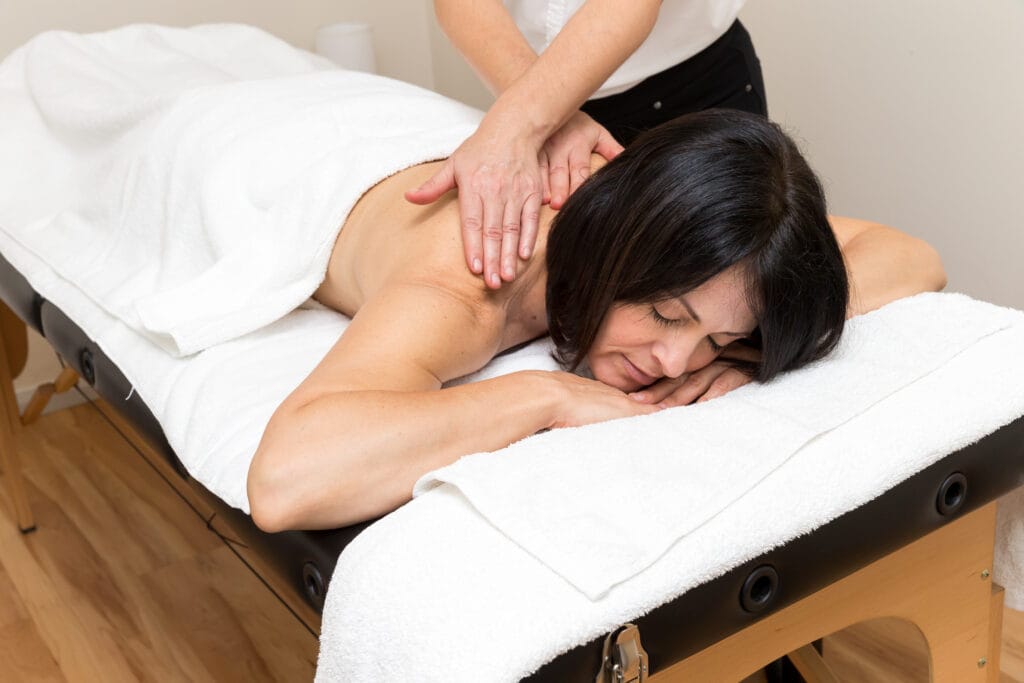
Remedial massage is not just about relaxation.
When applied appropriately, it can:
- Reduce excessive muscle tone
- Improve local circulation
- Decrease protective guarding
- Support nervous system regulation
- Create a window for better movement
- Create a relaxation response
This is particularly helpful in midlife, where stress load and hormonal changes can amplify muscle reactivity. Massage works best when combined with appropriate strength and movement strategies. It prepares the body to move more efficiently rather than simply masking symptoms
.
When massage is most useful
Remedial massage can be particularly helpful if:
- Muscle tension returns quickly after exercise
- You feel “held” or restricted in the neck, shoulders or hips
- Stress levels are high
- Sleep is disrupted
- You struggle to switch off physically
However, persistent or recurrent pain should still be properly assessed. If tension is linked to joint loading, movement patterns or stability deficits, a physiotherapy assessment may be required alongside massage.
The key takeaway
Muscle tension building faster after 45 is common. It is influenced by hormonal shifts, stress load and changes in tissue recovery. Stretching has a role. So does strength training.
Remedial massage can be a valuable part of a broader plan, helping to reduce protective tension and support recovery. The goal is not simply to feel looser for a day. It is to create a body that adapts better to the demands placed on it.
Related reading
- Why Pain Keeps Coming Back Even When You Exercise and Stretch
- How Stress and Poor Sleep Increase Pain in Midlife Women
- Why Rest Alone Does Not Fix Pain in Midlife Women – THIS ONE NEEDS A LINK